
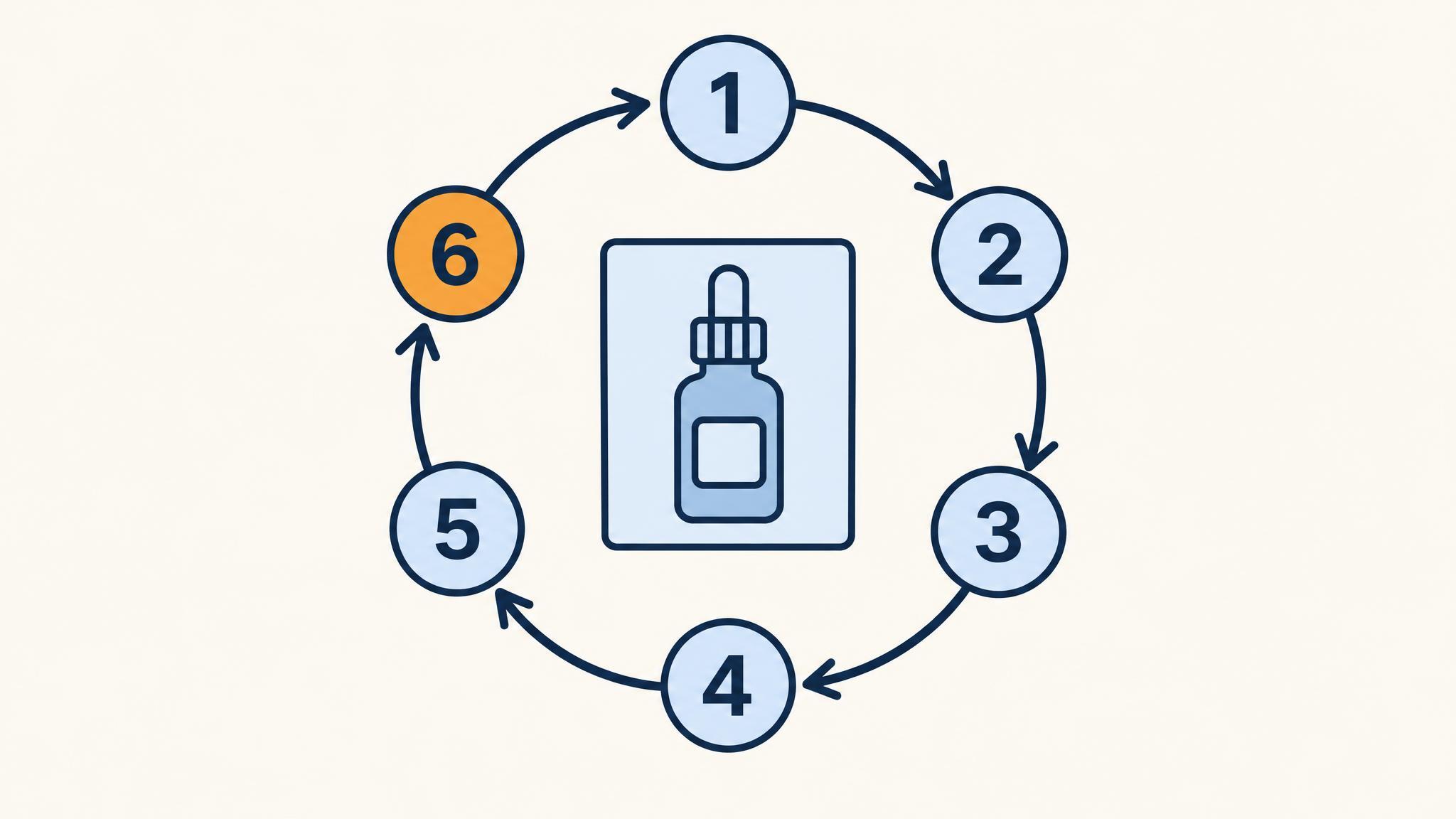
A creative testing framework is a fixed routine for deciding which ads you test, where they run, what they spend and what happens next. On Meta, it turns paid social creative from guesswork into a weekly habit. You need one because winners are scarce. Motion's 2026 Creative Benchmarks found that roughly 5% of Meta creatives become winners, meaning ads that far outspend the others in their account. The dataset covers 578,750 creatives and $1.29 billion in ad spend. This guide gives you a six-step system built on Meta's own documentation: hypotheses, ranking, test setup, budget, decision rules and a log.
Source: Motion, "Creative Benchmarks 2026," section "Winners are rare," 2026, https://runneth.com/library/research/creative-benchmarks-2026/winners-are-rare, retrieved 2026-11-20; Motion's research library now sits on runneth.com, and the old motionapp.com research links redirect there
Key Takeaways:
- Roughly 5% of Meta creatives win outsized spend (Motion, 2026), so plan for misses.
- Test big swings first: concept, format, then hook.
- As of November 2026, Meta's creative test compares up to seven variants.
- Run tests at least seven days (Meta's A/B guidance, November 2026) and write kill rules first.
- Log every result; the next test builds on it.
Source: Motion, "Creative Benchmarks 2026," section "Winners are rare," 2026, https://runneth.com/library/research/creative-benchmarks-2026/winners-are-rare, retrieved 2026-11-20
Source: Meta Business Help Center, "Set up a creative test in Meta Ads Manager," 2026, https://www.facebook.com/business/help/1423851372208214, retrieved 2026-11-20
Source: Meta Business Help Center, "Best practices for A/B tests in Meta Ads Manager," 2026, https://www.facebook.com/business/help/290009911394576, retrieved 2026-11-20
What is a creative testing framework?
It's a written set of rules for how new ads get tested, funded and judged. The rules exist because many ads never get meaningful spend. In Motion's 2026 Creative Benchmarks, which cover 6,015 advertiser accounts, about half of all ads received little or no spend.
Source: Motion, "Creative Benchmarks 2026," section "Winners are rare," 2026, https://runneth.com/library/research/creative-benchmarks-2026/winners-are-rare, retrieved 2026-11-20
In a test, you run different versions of an ad creative against the same audience and compare what each one costs per result. Research firms also use "creative testing" for panel studies run before launch, but this guide covers live tests inside Meta Ads Manager.
A creative testing framework is a repeatable process for testing ads on Meta. It defines what to test, as a ranked backlog of hypotheses, and where each test runs. It also sets the budget and time a test gets, the rules for calling a winner or a loser, and how every lesson gets recorded.
The system in this guide has six steps:
- Write a backlog of hypotheses.
- Rank the ideas by the size of the swing.
- Pick where the test runs in the ad account.
- Set the budget and the clock.
- Judge every ad by rules written before launch.
- Graduate winners and log the lesson.
One caution on Motion's number. A "winner" in that dataset is defined by spend: at least 10 times the account's median ad and at least $500. Motion's methodology notes that a winner by spend can still lose money. The data also covers September 2025 to January 1, 2026, a holiday-heavy window. So judge your own ads on your own cost per result.
Source: Motion, "Creative Benchmarks 2026," section "Winners are rare," 2026, https://runneth.com/library/research/creative-benchmarks-2026/winners-are-rare, retrieved 2026-11-20
Source: Motion, "Creative Benchmarks 2026," section "Methodology," 2026, https://runneth.com/library/research/creative-benchmarks-2026/methodology, retrieved 2026-11-20
Why ad creative testing matters more on Meta in 2026
Meta's average price per ad has risen year over year in each of the last two quarters. Meta's third-quarter 2026 results, released on October 21, 2026, reported a 14% rise. The second-quarter release, from July 29, 2026, reported 12%. Ad impressions grew 10% in the third quarter. When every impression costs more, a weak ad wastes more money, and creative is the input you control most directly.
Source: Meta Platforms, "Meta Reports Third Quarter 2026 Results," 2026, https://investor.atmeta.com/investor-news/press-release-details/2026/Meta-Reports-Third-Quarter-2026-Results/default.aspx, retrieved 2026-11-20
Source: Meta Platforms, "Meta Reports Second Quarter 2026 Results," 2026, https://investor.atmeta.com/investor-news/press-release-details/2026/Meta-Reports-Second-Quarter-2026-Results/default.aspx, retrieved 2026-11-20
Winners are scarce: plan for about one creative in twenty to earn outsized spend. Illustrative image generated for this article.
Older research points the same way. A 2017 analysis by Nielsen Catalina Solutions of nearly 500 consumer goods campaigns across all media attributed 47% of advertising's sales contribution to creative. Reach came second at 22%, and targeting accounted for 9%. The study predates today's Meta auction and covers packaged goods, so read it as direction, not as a benchmark for your account.
Source: Nielsen, "When It Comes to Advertising Effectiveness, What Is Key?," 2017, https://www.nielsen.com/insights/2017/when-it-comes-to-advertising-effectiveness-what-is-key/, retrieved 2026-11-20
Kantar and WARC reached a similar conclusion in 2023. Their joint analysis matched about 450 ads to profit figures from WARC's database of award entries. Ads in the top tier for creative quality generated more than four times the profit of ads in the bottom tier. Kantar sells ad testing, so weigh that.
Source: Kantar, "The Art of Proof: How Creative Quality Drives Profit," 2023, https://www.kantar.com/north-america/inspiration/advertising-media/the-art-of-proof-how-creative-quality-drives-profit, retrieved 2026-11-20
Creative testing matters more on Meta in 2026 because ads cost more than a year ago and winners are scarce. Meta reported a 14% year-over-year rise in average price per ad for the third quarter of 2026. Motion's 2026 benchmarks show only about 5% of creatives earn outsized spend. A testing routine finds those ads sooner.
Source: Meta Platforms, "Meta Reports Third Quarter 2026 Results," 2026, https://investor.atmeta.com/investor-news/press-release-details/2026/Meta-Reports-Third-Quarter-2026-Results/default.aspx, retrieved 2026-11-20
Source: Motion, "Creative Benchmarks 2026," section "Winners are rare," 2026, https://runneth.com/library/research/creative-benchmarks-2026/winners-are-rare, retrieved 2026-11-20
THE 2X TAKE
Don't treat testing as a side project you fund when the month looks good. We'd ring-fence a fixed slice of spend for it every week.
Steps 1 and 2: How do you decide what to test?
Most accounts get only a handful of test slots each week. Motion's 2026 benchmarks put the average at 4.1 new creatives a week for accounts spending $10,000 to $50,000 a month. Accounts spending $50,000 to $200,000 averaged 6.6. Motion's table also gives the smaller tier an average hit rate of 6.4%, averaged account by account. Don't read it as the same measure as the roughly 5% winner share quoted earlier. With so few slots, what goes into them matters more than how many you fill.
Source: Motion, "Creative Benchmarks 2026," page "Weekly testing volume and hit rate by advertiser spend tier," 2026, https://runneth.com/library/research/creative-benchmarks-2026/testing-volume-by-tier, retrieved 2026-11-20
Step 1: write a backlog of hypotheses. A hypothesis is a guess you can prove wrong. Use one sentence: "Because of this observation, we believe this change will improve this metric." Take a skincare brand whose reviews keep mentioning sensitive skin. Its hypothesis might be that a dermatologist-style demo will beat the founder story on cost per purchase.
Good observations come from places your customers already talk: product reviews, support tickets, ad comments and, for SaaS teams, sales-call notes. Keep the list in one shared document and add to it every week.
Step 2: rank the ideas by the size of the swing. Sort the backlog into four levels:
- Concept: the promise and who it's for. "Calms sensitive skin" and "replaces three products" are different concepts.
- Format: how the idea is delivered, such as a user-generated content (UGC) video, a static image or a product demo.
- Hook: the first seconds of a video or the headline of a static.
- Element: small details like button text, captions or background color.
Test from the top down. Our view is that two concepts usually differ far more in results than two button labels do. A big difference also shows up with less data. Whatever you test, Meta's A/B testing guidance says results are more conclusive when versions are identical except for the one variable under test. So keep the offer, landing page and audience fixed.
Source: Meta Business Help Center, "Best practices for A/B tests in Meta Ads Manager," 2026, https://www.facebook.com/business/help/290009911394576, retrieved 2026-11-20
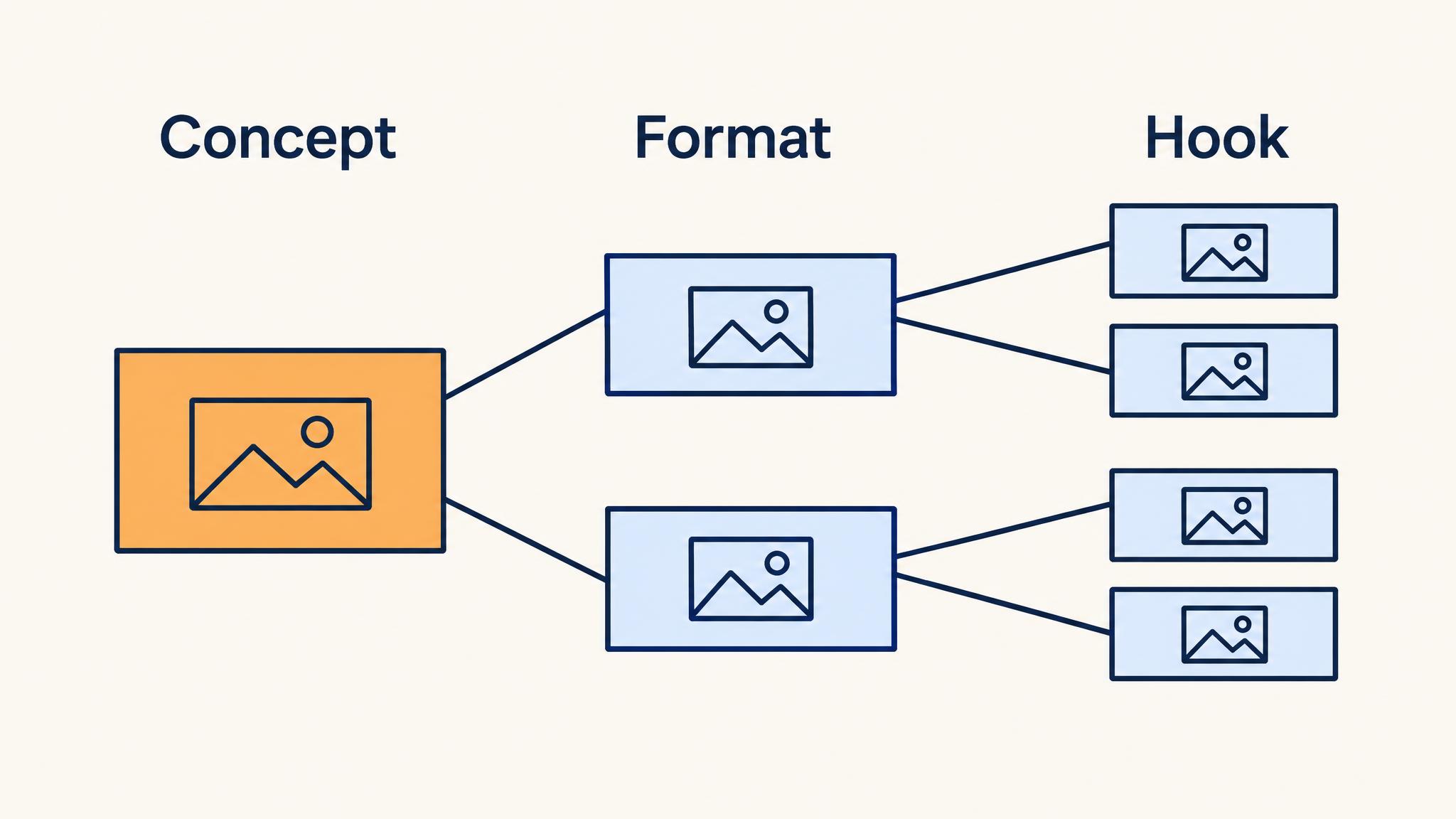
Test the biggest swing first: concept, then format, then hook. Illustrative image generated for this article.
Decide what to test by writing each idea as a hypothesis, then ranking it by how different it is from what's already running. Test new concepts first, formats second, hooks third and small elements last. One of Meta's recommendations for a fatigued ad is a new image or video that is materially different from the original.
Source: Meta Business Help Center, "About creative fatigue recommendations in Meta Ads Manager," 2026, https://www.facebook.com/business/help/1346816142327858, retrieved 2026-11-20
THE 2X TAKE
Ask what a customer would say the ad was about. If two test ads get the same answer, they're one concept. We'd launch three different ideas before nine tweaks of one. For reference points on formats, see this portfolio of past ad creative.
Step 3: Where should Facebook creative testing run?
There's now a tool built for this job: a creative test in Ads Manager, which compares creative variants inside an existing campaign. Its limit has moved. Jon Loomer Digital's walkthrough, published in October 2025, described two to five test ads. In June 2026 the same site reported a seven-ad version while Meta's documentation still showed five. Meta's Business Help Center, read in November 2026, says up to seven. So check the tool itself. You have three places to run a test.
Source: Jon Loomer Digital, "Meta's Creative Testing Tool: Setup, Strategy, and Results," 2025, https://www.jonloomer.com/meta-creative-testing/, retrieved 2026-11-20
Source: Jon Loomer Digital, "AI Disclosure Checkbox, ChatGPT Attribution, and More," 2026, https://www.jonloomer.com/ai-disclosure-checkbox-chatgpt-attribution/, retrieved 2026-11-20
Source: Meta Business Help Center, "Set up a creative test in Meta Ads Manager," 2026, https://www.facebook.com/business/help/1423851372208214, retrieved 2026-11-20
Option 1: Meta's creative test. As of November 2026, you copy an existing ad two to seven times and swap the creative in each copy. Then you choose a share of budget, a duration and a comparison metric. Meta suggests using no more than 20% of the existing budget. The test only works with the Highest volume bid strategy. Results come without a confidence level, and Meta makes no automatic changes when the test ends.
Source: Meta Business Help Center, "Set up a creative test in Meta Ads Manager," 2026, https://www.facebook.com/business/help/1423851372208214, retrieved 2026-11-20
Option 2: a formal A/B test. An A/B test splits your audience so nobody sees both versions, then compares cost per result. Meta recommends it for comparing two strategies. It also advises against informal testing, such as switching ad sets on and off by hand. Use it for one big question, like UGC against studio footage, when you need a clean read.
Source: Meta Business Help Center, "About A/B testing for Meta ads," 2026, https://www.facebook.com/business/help/1738164643098669, retrieved 2026-11-20
Option 3: a separate testing ad set. New ads go into their own ad set with its own budget, and winners get copied into the ad set you scale. Any change to ad creative, and adding a new ad to an ad set, count as significant edits. Those edits send the ad set back into the learning phase. That's the period when Meta's delivery system is still working out how to deliver an ad set, and results are less stable. Dropping test ads into your best ad set every week keeps resetting it. Meta's creative test page doesn't say whether its own test ads count as that kind of edit to the host ad set. It does say the test sits in an existing campaign so strong ads can keep running afterwards with delivery system learnings retained.
Source: Meta Business Help Center, "Significant edits and learning phase," 2026, https://www.facebook.com/business/help/316478108955072, retrieved 2026-11-20
Source: Meta Business Help Center, "About the learning phase for ad sets in Meta Ads Manager," 2026, https://www.facebook.com/business/help/112167992830700, retrieved 2026-11-20
Source: Meta Business Help Center, "Set up a creative test in Meta Ads Manager," 2026, https://www.facebook.com/business/help/1423851372208214, retrieved 2026-11-20
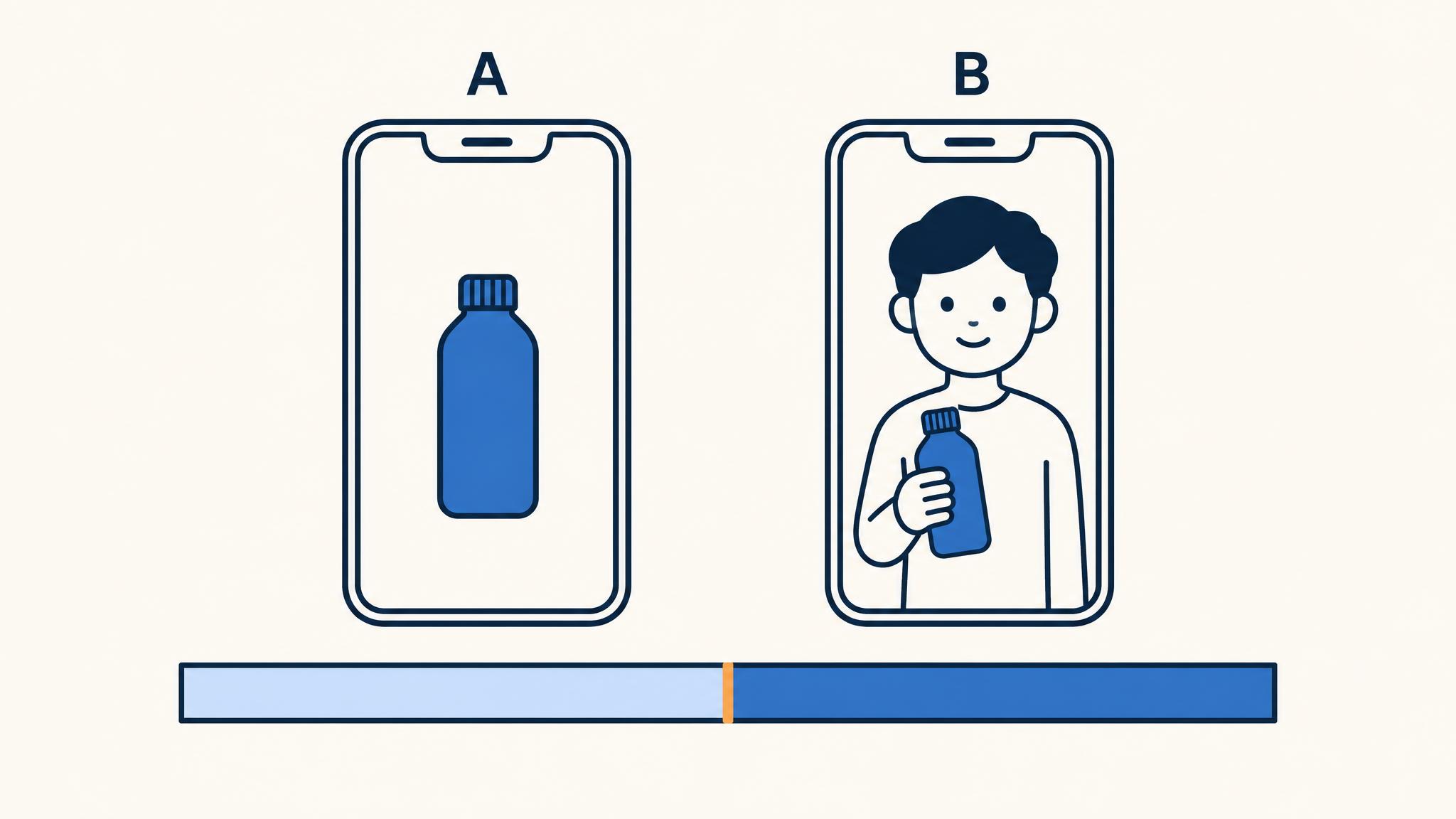
Same product, two versions of the ad, an even split of test budget. Illustrative image generated for this article.
On Meta, creative tests run in three places. As of November 2026, Meta's built-in creative test takes two to seven variants with Highest volume bidding. Meta suggests no more than 20% of the existing budget. An A/B test splits the audience for a clean read. A separate testing ad set keeps new ads from resetting learning on proven ones.
Source: Meta Business Help Center, "Set up a creative test in Meta Ads Manager," 2026, https://www.facebook.com/business/help/1423851372208214, retrieved 2026-11-20
Source: Meta Business Help Center, "About A/B testing for Meta ads," 2026, https://www.facebook.com/business/help/1738164643098669, retrieved 2026-11-20
Source: Meta Business Help Center, "Significant edits and learning phase," 2026, https://www.facebook.com/business/help/316478108955072, retrieved 2026-11-20
THE 2X TAKE
Start with Meta's creative test if you already bid on Highest volume. Meta aims to spend the amount you set on the test ads each day. Watch your proven ads for the first few days. We'd save A/B tests for account-wide decisions. Use a separate ad set if you bid to a cost goal or a ROAS goal (return on ad spend: revenue divided by ad cost).
Source: Meta Business Help Center, "Set up a creative test in Meta Ads Manager," 2026, https://www.facebook.com/business/help/1423851372208214, retrieved 2026-11-20
Step 4: How much budget and time does a test need?
Your yardstick comes from Meta's delivery system. Meta's Business Help Center, read in November 2026, says an ad set usually leaves the learning phase after about 50 results. Those results need to arrive in the week after its last significant edit. Until then, Meta says performance is less stable and cost per result usually runs higher.
Source: Meta Business Help Center, "About the learning phase for ad sets in Meta Ads Manager," 2026, https://www.facebook.com/business/help/112167992830700, retrieved 2026-11-20
Turn that into a budget. Meta published a formula for this on October 21, 2026, in a post about peak-season purchase campaigns. Total weekly budget, divided by the cost of 50 results, gives the most ad sets your budget can support. In Meta's analysis, ad sets below roughly 50 conversions a week ran about 28% more expensive per purchase. Say your target cost per acquisition (CPA), the amount you can pay for one customer, is $40. Fifty purchases a week then costs about $2,000, or roughly $286 a day for one ad set. If you don't know your target yet, work back from break-even with a ROAS calculator.
Source: Meta for Business, "Peak Season 2026: You Don't Beat The Auction. You Brief It.," 2026, https://www.facebook.com/business/news/you-dont-beat-the-auction-you-brief-it, retrieved 2026-11-20
Many test budgets can't reach that level. Then test fewer ads at once so each gets more spend, or accept a directional read and confirm it at scale.
Those two yardsticks do different jobs. About 50 results a week is Meta's bar for an ad set that delivers stably. Use it when a test must stand in for scaled performance. For a directional read, our starting floor is lower: two to three target CPAs of spend per ad. Below that floor, don't rank the ads at all. A test funded at the floor can screen out losers, but it can't name a winner. A graduate call needs more spend.
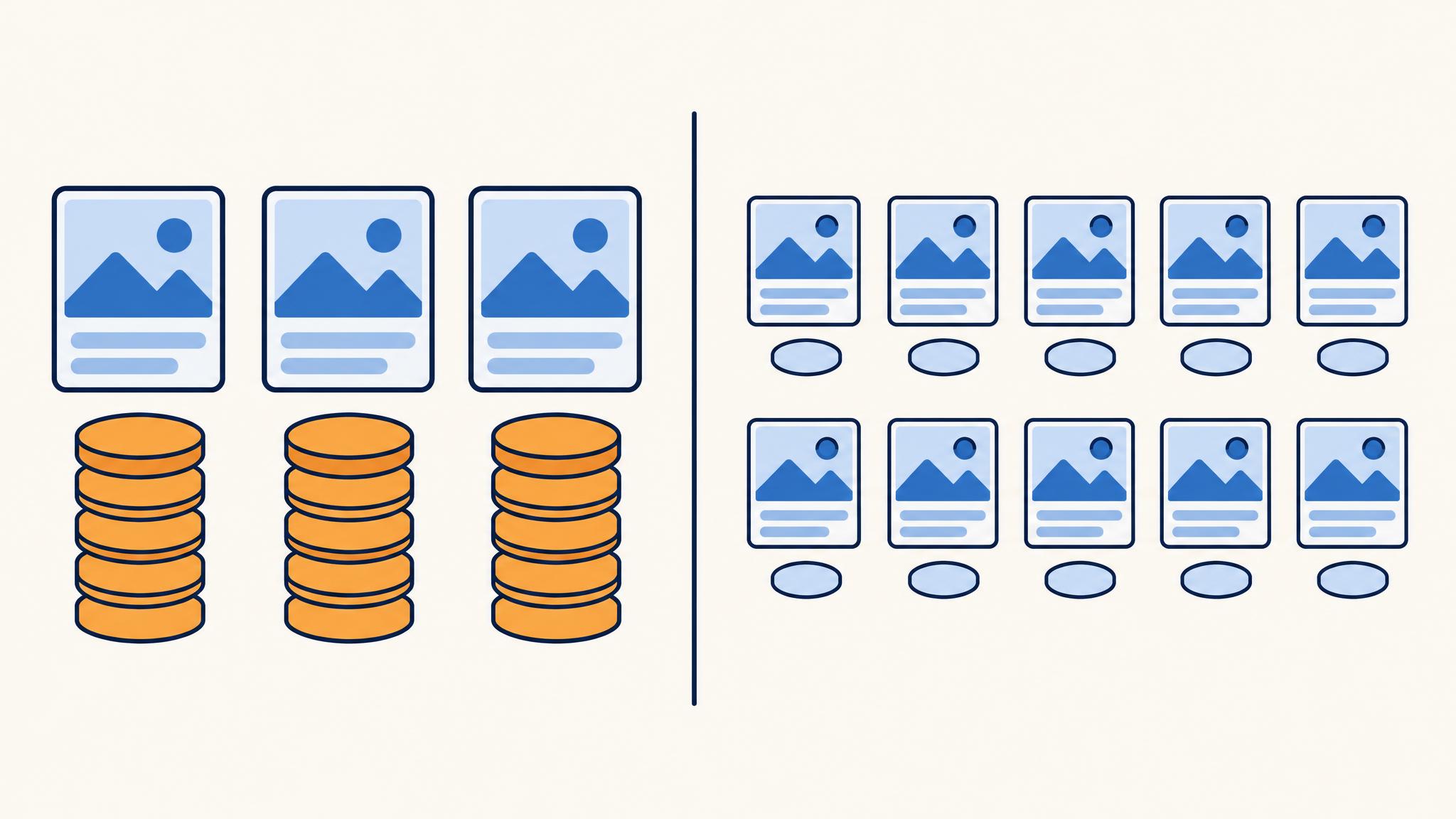
Fewer ads in the test, each with enough budget to give a read. Illustrative image generated for this article.
As of November 2026, Meta's best practices for A/B tests say to run tests for at least seven days, with a maximum of 30. Shorter tests may be inconclusive. Some buyers take longer than a week to convert, as can happen with a SaaS free trial. For those cases Meta suggests a longer window, such as ten days.
Source: Meta Business Help Center, "Best practices for A/B tests in Meta Ads Manager," 2026, https://www.facebook.com/business/help/290009911394576, retrieved 2026-11-20
Don't overfill the account either. Meta warns that when you run too many ads at once, each ad delivers less often and fewer exit learning. As of November 2026, Meta caps some Pages at 250 ads running or in review. The cap applies to Pages that have spent under $100,000 in their highest-spending month since September 2019. Motion's 2026 data adds a planning number: an advertiser testing four ads a week surfaces roughly 0.2 winners a week. That's about one winner every five weeks.
Source: Meta Business Help Center, "About managing ad volume," 2026, https://www.facebook.com/business/help/2720085414702598, retrieved 2026-11-20
Source: Meta Business Help Center, "Ad limits per Page," 2026, https://www.facebook.com/business/help/766697140509126, retrieved 2026-11-20
Source: Motion, "Creative Benchmarks 2026," section "Winners are rare," 2026, https://runneth.com/library/research/creative-benchmarks-2026/winners-are-rare, retrieved 2026-11-20
Every creative test on Meta needs enough budget to produce results and enough time to read them. As of November 2026, Meta says ad sets usually exit the learning phase after about 50 results in a week. Its A/B test guidance says tests shorter than seven days may be inconclusive. Budget backwards from your target cost per result.
Source: Meta Business Help Center, "About the learning phase for ad sets in Meta Ads Manager," 2026, https://www.facebook.com/business/help/112167992830700, retrieved 2026-11-20
Source: Meta Business Help Center, "Best practices for A/B tests in Meta Ads Manager," 2026, https://www.facebook.com/business/help/290009911394576, retrieved 2026-11-20
THE 2X TAKE
An underfunded test is an easy way to learn nothing. We'd rather run three ads properly than ten on scraps. If a test can't give each ad that floor of two to three target CPAs, cut the number of ads. It's a starting rule of ours, not Meta's, so adjust it for your account.
Steps 5 and 6: Read the result, then log the lesson
Don't expect a verdict from Meta. Its creative test reports top performers against your chosen metric but includes no confidence level. Its ad relevance diagnostics don't appear until an ad has 500 impressions, according to Meta's Business Help Center in November 2026. So you need your own rules, written before launch.
Source: Meta Business Help Center, "Set up a creative test in Meta Ads Manager," 2026, https://www.facebook.com/business/help/1423851372208214, retrieved 2026-11-20
Source: Meta Business Help Center, "About ad relevance diagnostics," 2026, https://www.facebook.com/business/help/403110480493160, retrieved 2026-11-20
Step 5: judge every ad by rules written before launch. Why before? Because once money is spent, every ad starts to look like it deserves one more day. The rules below are starting points of ours, not Meta's. Adjust the numbers to your own account before you use them:
- Kill: the ad has spent two to three times your target CPA with no conversion.
- Wait: the ad converts, but CPA sits above target. Let it finish the test window, then decide once.
- Graduate: CPA is at or below target after seven days or more. One conversion more or fewer wouldn't change the call.
Some ads will sit at target on thin data, such as two or three conversions. That isn't a graduate yet. Keep the ad running until it has enough conversions to read, then apply the same rules.
When an ad loses, find out where it lost. Check how many people watched past the first seconds. Then check click-through rate, the share of viewers who clicked, and how many clickers converted. A strong hook with a weak conversion rate is a different problem from an ad nobody stopped for. Where one ad holds several images or videos, open Breakdown in Ads Manager, then Creative, then Media, to see results for each asset. Meta's help page, read in November 2026, says the view may not be available to every account.
Source: Meta Business Help Center, "View creative performance for individual media assets in your ad," 2026, https://www.facebook.com/business/help/1822387965412520, retrieved 2026-11-20
Apart from the kill rule, leave the test alone while it runs. Meta's guidance is to wait until an ad set is out of the learning phase before you edit it, because a significant edit restarts learning.
Source: Meta Business Help Center, "About the learning phase for ad sets in Meta Ads Manager," 2026, https://www.facebook.com/business/help/112167992830700, retrieved 2026-11-20
Source: Meta Business Help Center, "Significant edits and learning phase," 2026, https://www.facebook.com/business/help/316478108955072, retrieved 2026-11-20
Step 6: graduate winners and log the lesson. With Meta's creative test, the ads keep running in the same campaign afterwards, so switch the losers off yourself. With a separate testing ad set, copy winners into your scaling ad set in one weekly batch, because each addition is a significant edit. Meta's October 2026 post makes the same general point: group your changes and take one learning phase, not several.
Source: Meta Business Help Center, "Set up a creative test in Meta Ads Manager," 2026, https://www.facebook.com/business/help/1423851372208214, retrieved 2026-11-20
Source: Meta Business Help Center, "Significant edits and learning phase," 2026, https://www.facebook.com/business/help/316478108955072, retrieved 2026-11-20
Source: Meta for Business, "Peak Season 2026: You Don't Beat The Auction. You Brief It.," 2026, https://www.facebook.com/business/news/you-dont-beat-the-auction-you-brief-it, retrieved 2026-11-20
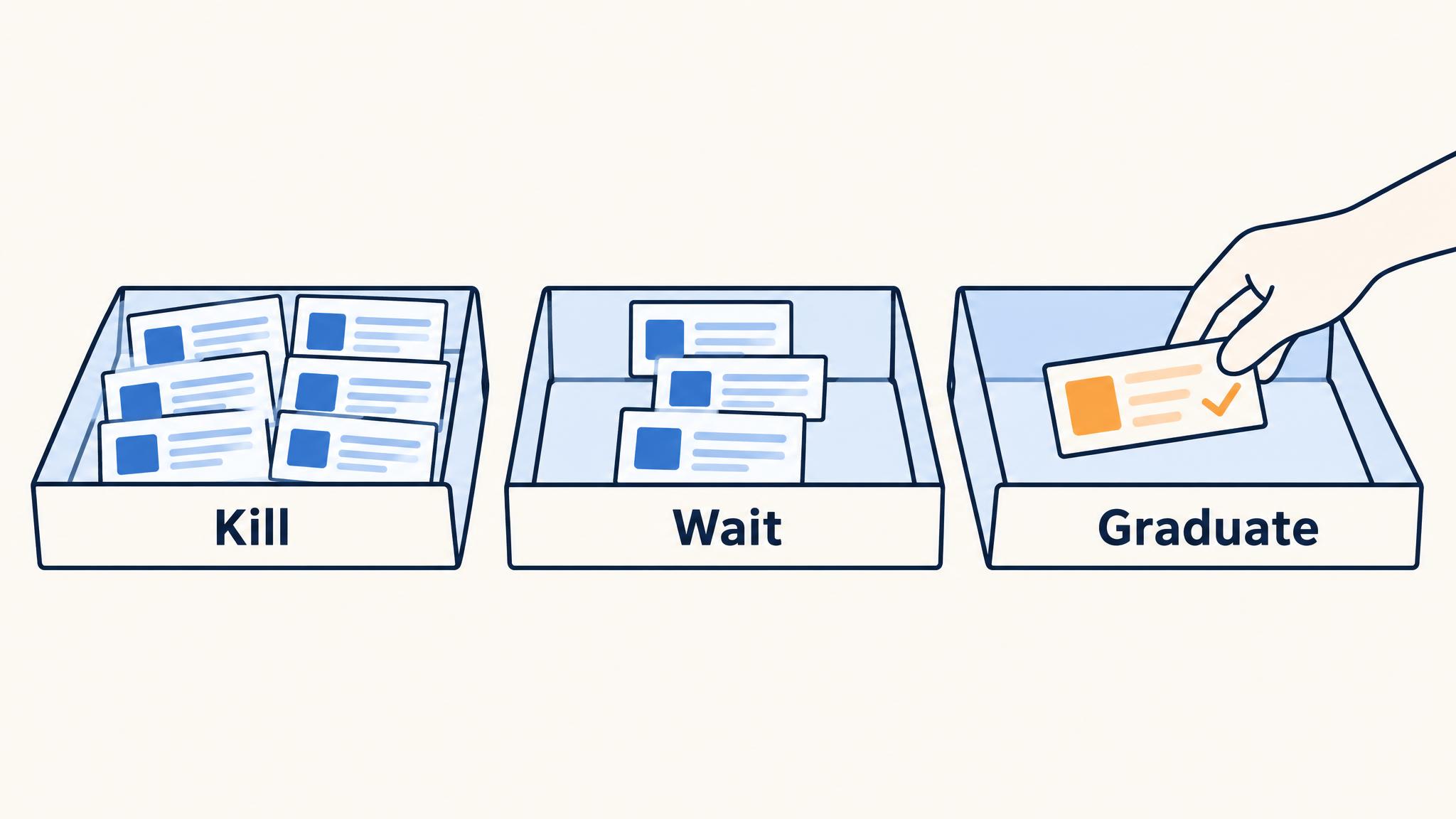
The weekly review sorts every ad into one of three calls. Illustrative image generated for this article.
Meta also tells you when a winner is wearing out. As of November 2026, the Delivery column shows "Creative limited" when cost per result is above your past ads but under double. It shows "Creative fatigue" at double or more. Meta weighs how often people have seen the creative, but the thresholds it publishes are about cost per result, not a set ad frequency. Meta makes the status available only for ad sets with one creative, and excludes Advantage+ catalog ads, dynamic creative and Advantage+ app campaigns. A testing ad set that holds several ads won't show it, so watch your own CPA trend as well.
Source: Meta Business Help Center, "About creative fatigue recommendations in Meta Ads Manager," 2026, https://www.facebook.com/business/help/1346816142327858, retrieved 2026-11-20
Then write it down. A test log needs only a few fields:
- Test name and dates, using one naming pattern such as 2026-11_sensitive-skin_ugc-demo_hook-b
- The hypothesis, word for word
- Concept, format and hook
- Setup and budget
- Result on the primary metric
- Decision: kill, wait or graduate
- The lesson in one sentence, and the next test it suggests
Judge creative tests by rules written before launch, because Meta's creative test reports top performers without a confidence level. Set a spend limit for ads with no conversions, a minimum run of seven days and a target cost per result. Then record the hypothesis, result and lesson so the next test builds on it.
Source: Meta Business Help Center, "Set up a creative test in Meta Ads Manager," 2026, https://www.facebook.com/business/help/1423851372208214, retrieved 2026-11-20
THE 2X TAKE
The log is the asset. Ads burn out, but a record of which promises your buyers respond to keeps its value. We'd review it monthly and ask one question: which concept keeps producing winners?
Frequently Asked Questions
What is creative testing?
Creative testing means running different versions of an ad against the same audience to see which gets the lowest cost per result. It matters because creative carries much of the outcome. A 2017 Nielsen analysis of nearly 500 consumer goods campaigns attributed 47% of advertising's sales contribution to creative, the largest share of any element.
Source: Nielsen, "When It Comes to Advertising Effectiveness, What Is Key?," 2017, https://www.nielsen.com/insights/2017/when-it-comes-to-advertising-effectiveness-what-is-key/, retrieved 2026-11-20
What is the 3 2 2 method of Facebook ads?
The 3-2-2 method loads three creatives, two primary texts and two headlines into one dynamic creative ad set, which Meta mixes into 12 combinations. Charley Tichenor described it in a 2023 Social Media Examiner article. Meta says dynamic creative may be unavailable for sales or app promotion campaigns since June 2024 and recommends flexible ad format.
Source: Social Media Examiner, "Scaling Your Facebook Ads: A Proven Strategy," 2023, https://www.socialmediaexaminer.com/scaling-your-facebook-ads-a-proven-strategy/, retrieved 2026-11-20
Source: Meta Business Help Center, "About managing ad volume," 2026, https://www.facebook.com/business/help/2720085414702598, retrieved 2026-11-20
How many creatives should you test per week on Meta?
There's no fixed number, but Motion's 2026 benchmarks give a reference point. Accounts spending $10,000 to $50,000 a month launched 4.1 new creatives a week on average. Accounts spending $50,000 to $200,000 launched 6.6. Test as many as your budget can fund properly, not as many as you can make.
Source: Motion, "Creative Benchmarks 2026," page "Weekly testing volume and hit rate by advertiser spend tier," 2026, https://runneth.com/library/research/creative-benchmarks-2026/testing-volume-by-tier, retrieved 2026-11-20
How long should a creative test run on Meta?
Run a creative test on Meta for at least seven days. Meta's A/B testing guidance, read in November 2026, says tests shorter than seven days may produce inconclusive results and allows up to 30 days. Extend the window if your customers usually take longer than a week to convert.
Source: Meta Business Help Center, "Best practices for A/B tests in Meta Ads Manager," 2026, https://www.facebook.com/business/help/290009911394576, retrieved 2026-11-20
Conclusion: start with one test this week
A creative testing framework comes down to six habits. Write hypotheses, rank them, choose a test setup, fund it, judge it by rules set in advance and log the lesson. With only about 5% of Meta creatives earning outsized spend in Motion's 2026 data, the routine matters more than any single ad.
Source: Motion, "Creative Benchmarks 2026," section "Winners are rare," 2026, https://runneth.com/library/research/creative-benchmarks-2026/winners-are-rare, retrieved 2026-11-20
Pick one hypothesis, set up one test with three ads and write the kill rule before you publish. If you'd like a second opinion on your testing setup, or need performance ad creative to fill the backlog, book a strategy call.