
Facebook ads for SaaS work when two things are true. You optimize for a product or pipeline event instead of clicks, and your budget can buy about 50 of those events a week. Miss either one and Meta, the company behind Facebook and Instagram, will spend your money efficiently on the wrong people.
The audience is there. Pew Research Center's 2026 social media fact sheet has 70% of US college graduates saying they ever use Facebook, with LinkedIn at 51%.
This guide covers the campaign setup, the conversion event to pick, targeting after Meta's 2025 changes, creative and the budget math. The Meta features and figures cited here come from Meta's own documentation, posts and results, read in November 2026.
Key Takeaways:
- Pew, 2026: 70% of US college graduates say they ever use Facebook; 51% say LinkedIn.
- Meta's help page (read November 2026): ad sets usually exit the learning phase after about 50 results in the week after their last significant edit.
- Optimize for trials, demos or qualified leads over clicks.
- Send CRM outcomes back through Meta's Conversions API, its server-side connection.
Do Facebook ads work for SaaS companies?
Yes, for most SaaS companies with a wide enough market. Pew's 2026 fact sheet counts US adults who say they ever use each platform: 70% for Facebook, 51% for Instagram and 31% for LinkedIn. In the same 2026 data, adults aged 30 to 49 come in at 78% for Facebook and 37% for LinkedIn.
Facebook ads work for SaaS as a demand-creation channel. Pew Research Center's 2026 data shows 70% of US college graduates say they ever use Facebook, against 51% for LinkedIn. Meta can reach software buyers before they search. Its job is to create the trials, demos and brand memory that search and sales convert later.
Search ads catch people who already want a tool, and Meta doesn't. Professor John Dawes of the Ehrenberg-Bass Institute put a number on that in May 2021. Up to 95% of business clients, his 2021 report says, aren't in the market for many goods and services at any one time. Dawes calls the 95% a heuristic, not a precise rule. On Meta you're mostly talking to buyers who aren't shopping yet.
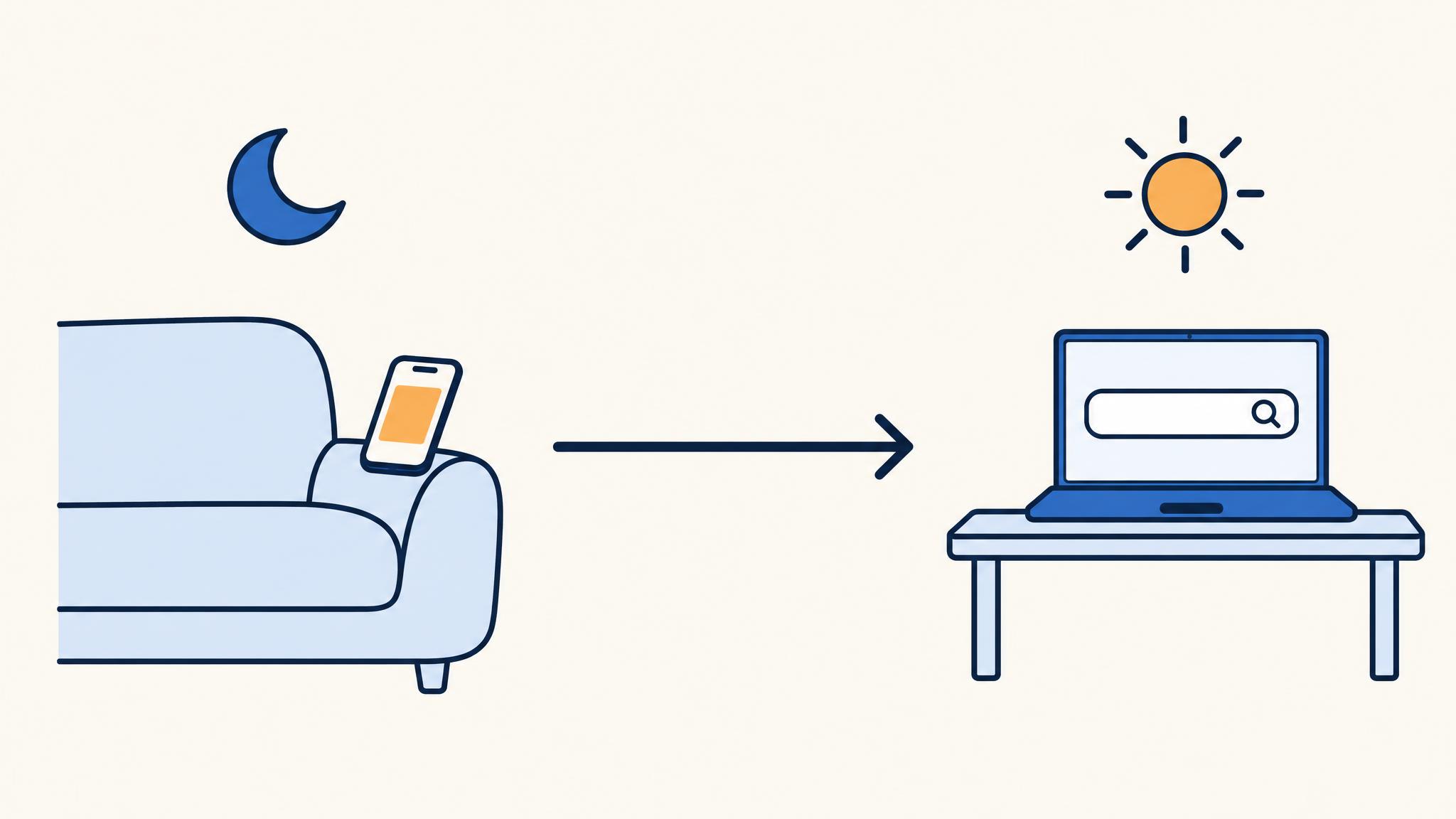
Generated image for illustration: Facebook and Instagram can reach software buyers off the clock, before they search for a tool.
That shapes who should run paid social campaigns on Meta and who should wait.
- Good fit: self-serve or low-touch products, a free trial or freemium tier, and a market of thousands of accounts.
- Workable: sales-led products with a mid-market price, a clear demo offer and a CRM that records what happens after the form.
- Poor fit: a few hundred named enterprise accounts and a sales cycle you can't report back to Meta within about a month.
For an example of SaaS paid acquisition, read the Puzzle Financial case study.
THE 2X TAKE
The campaign setup that fits a SaaS funnel
Advantage+ is Meta's name for automated campaign settings, where the delivery system chooses budget split, audience and placements (where ads appear). Meta's Business Help Center, read in November 2026, reports early tests with it on: 14% lower cost per lead and 10% lower per qualified lead. Both figures are averages and come from Meta's own tests of leads campaigns against Advantage+ off, so read them as direction.
It's also the starting setup for the Leads and Sales objectives. Meta's October 2025 announcement called Advantage+ leads campaigns globally available. The help page still warns the feature may not be in every account, so check yours.
Setting up Facebook ads for SaaS comes down to two choices. Sales-led companies use the Leads objective with instant forms, a website form, or both. Product-led companies send people to their site and optimize for a sign-up or trial event. As of November 2026, both start in Meta's automated Advantage+ setup.
Meta's Ads Manager help page, read in November 2026, lists six campaign objectives: Awareness, Traffic, Engagement, Leads, App promotion and Sales. A SaaS company needs two. We'd use Leads when the action is a demo request or sign-up, and Sales when someone pays at checkout. That split is our recommendation, so check which conversion events your account offers under each. Skip Traffic for acquisition, because it finds people who click and clicks don't start trials.
Sales-led: demo and contact-sales funnels
Choose the Leads objective, then a conversion location, which is where the action happens: an instant form or your own site. An instant form opens inside Facebook or Instagram and can pre-fill contact details the person already gave Meta.
Instant forms are built for volume, so add friction on purpose. Meta's help page lists a higher-intent form type, custom questions and work email validation. Meta's October 2025 announcement let one campaign use both locations. That 2025 post reported 14% to 24% lower cost per lead than website forms alone. Judge either route on lead conversion rate to qualified opportunity.
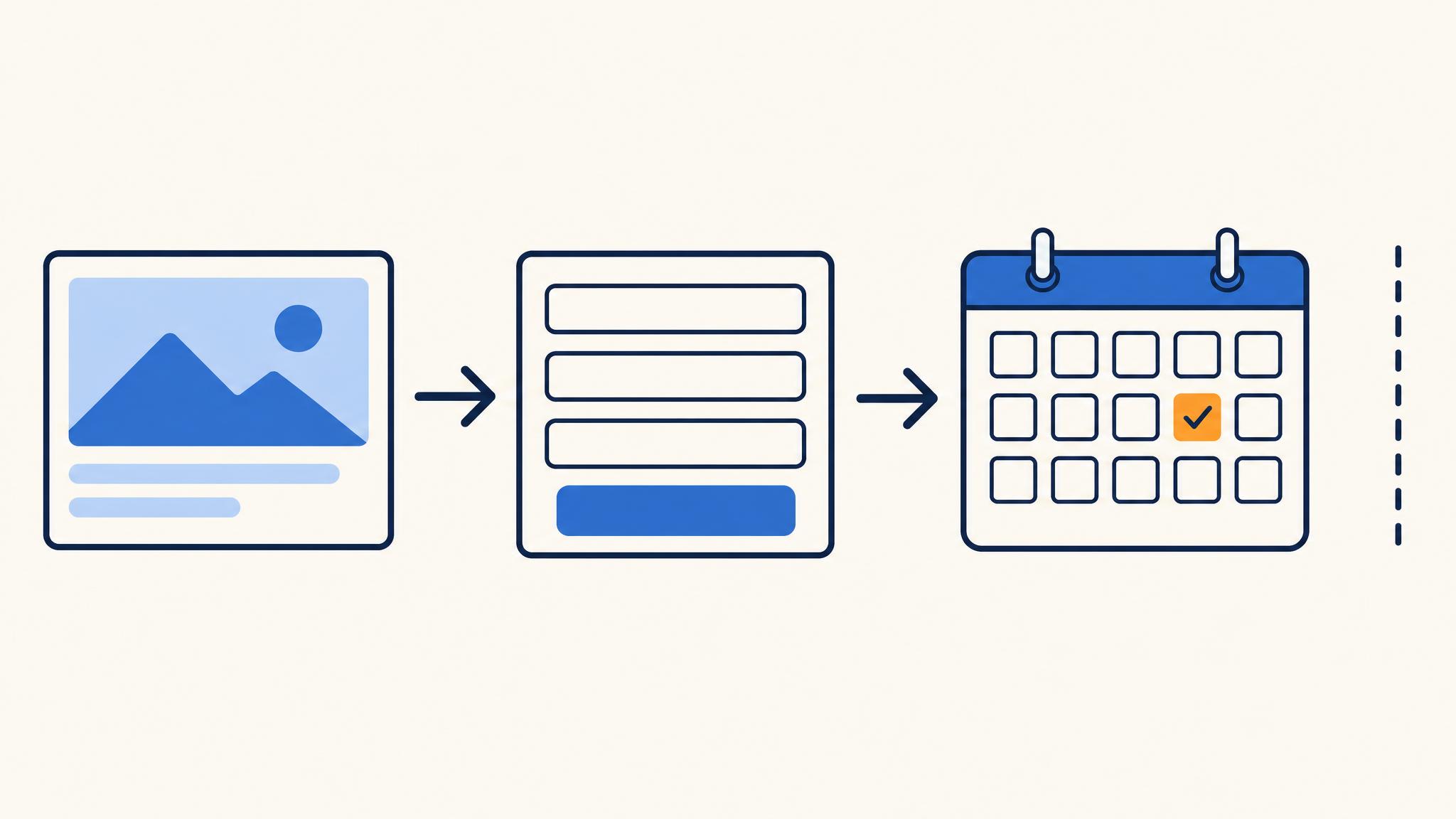
Generated image for illustration: for sales-led SaaS the ad's job ends at a booked demo, so judge a lead form by the calls it produces.
Product-led: free trial and freemium funnels
Send people to a landing page that repeats the ad's promise and asks for one action. Meta's pixel, the tracking code on your site, has standard events named StartTrial, CompleteRegistration and Subscribe. Pick the one that matches your sign-up flow. Fire it only when the account exists.
THE 2X TAKE
What should you tell Meta to optimize for?
The deepest funnel event you can generate about 50 times a week per ad set. Meta's learning-phase page, read in November 2026, says ad sets usually exit learning after about 50 results in the week after their last significant edit. That phase is when the delivery system is still working out who should see an ad set. An ad set is the campaign level where you choose audience, placements and optimization event.
A Meta peak-season post about shoppers and purchases puts a price on falling short. Meta's analysis, published in October 2026, found ad sets under roughly 50 conversions a week ran about 28% more expensive per purchase. Carrying the threshold over to SaaS leads and trials is our inference.
Optimize Meta campaigns for the deepest funnel event that still happens about 50 times a week per ad set. As of November 2026, Meta says ad sets usually exit the learning phase after about 50 results in the week after their last significant edit. For SaaS that means leads or trial starts first, then qualified leads and paid conversions.
Think of your funnel as a ladder of events, from shallow to deep:
- Lead or trial start. A form fill, a new account or a free trial. Highest volume, weakest signal.
- Qualified lead or activated account. Sales accepted the lead, or the user reached your activation milestone.
- Closed deal or paid subscription. The strongest signal and the scarcest.
Start on the deepest rung that clears about 50 a week. Go one rung deeper only when that rung clears it too.
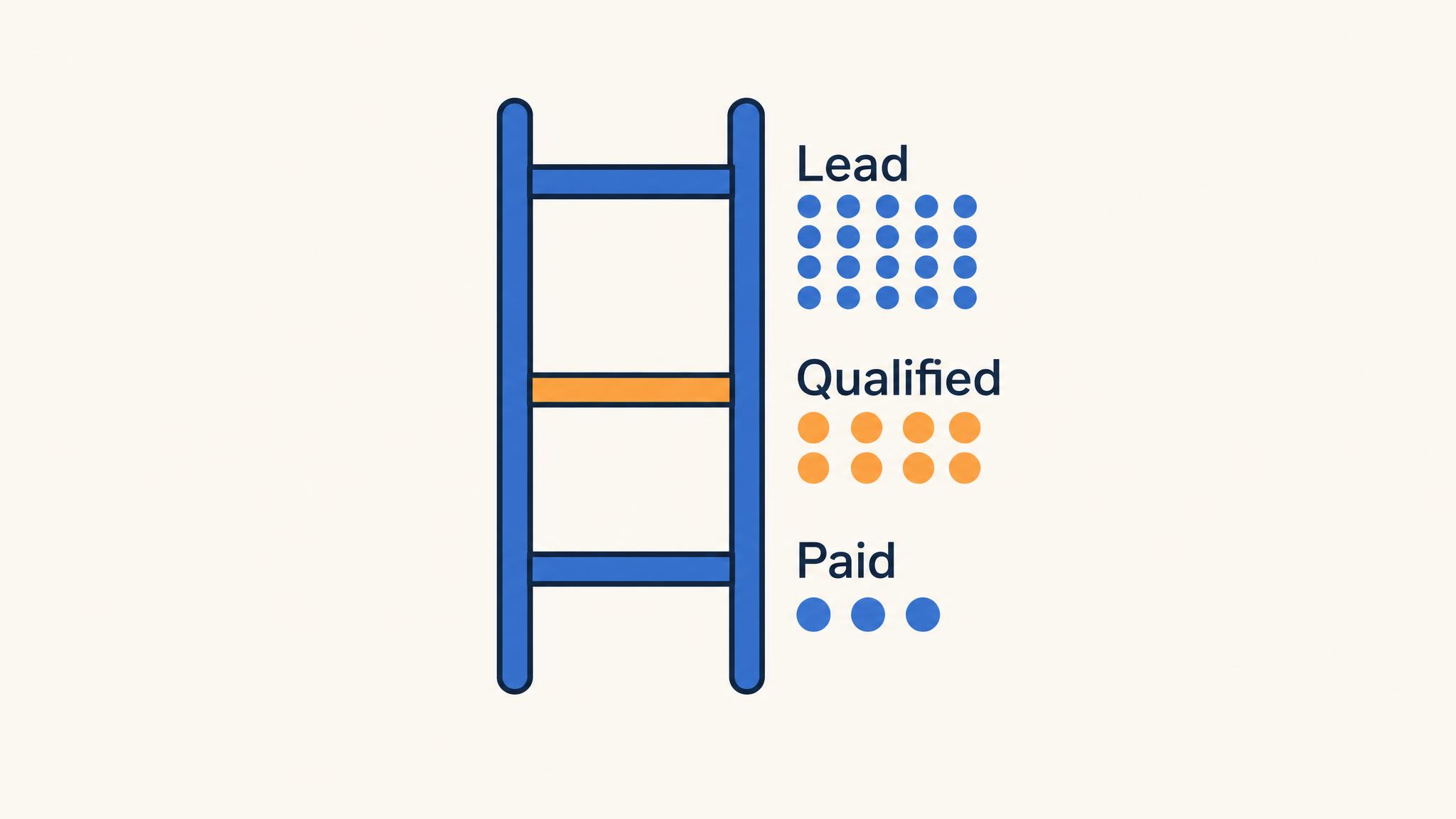
Generated image for illustration: choosing which funnel stage Meta should optimize for is a volume question before it's a quality question.
Deeper events usually happen off the page, in your product database or CRM, and the Conversions API is Meta's server-side connection for sending them. Without it, Meta only sees the form fill, and it will find you more people who fill forms.
Meta's October 2025 post reported, on average, 19% lower cost per quality lead for advertisers pairing a CRM connection with the conversion leads performance goal. That goal tells Meta to chase leads likely to reach a later sales stage. Meta's CRM integration guide, updated October 27, 2026, says the goal currently works with instant forms only. Its FAQ, updated March 24, 2026, also lists website forms, so check what your account offers.
Meta's October 2026 guide asks for 200 leads a month, a stage reached within 28 days and a 1% to 40% conversion rate. Meta's October 2025 post said the minimum lead volume was being removed, so treat the 200 as a rough marker. That feedback loop is what separates cheap leads from a healthy customer acquisition cost (CAC).
As of November 2026, Meta's standard settings credit conversions within 1 or 7 days of a link click and 1 day of a view. A third setting, engage-through, credits them 1 day after other clicks or a five-second video play. Some accounts may still use the older definitions during the rollout. A 45-day sales cycle won't fit inside those windows, so check Meta's numbers against your own attribution model and your CRM. The same page also describes incremental and custom attribution models.
THE 2X TAKE
SaaS Facebook ads targeting in 2026: what still works
Less targeting now works better than more. Meta began removing detailed targeting exclusions from Ads Manager on March 31, 2025, its updates page says. Detailed targeting is Meta's menu of interests, behaviors and demographics. The page's entry dated June 10, 2025, cites an advertiser test: 22.6% lower median cost per conversion without those exclusions.
Meta then started merging overlapping interests on June 23, 2025. It said campaigns still using retired options would stop delivering on January 15, 2026. Interest targeting isn't gone, but it's coarser, and inside Advantage+ audience it works as a suggestion. As of November 2026, Meta's help page says campaigns can achieve 9.7% lower cost per result with Advantage+ audience on Traffic, Engagement and Leads campaigns. It doesn't recommend the setting for retargeting, meaning ads to people who already know you.
Targeting SaaS buyers on Meta in 2026 relies on your own data more than on interest lists. Meta consolidated detailed targeting interests in 2025 and removed detailed targeting exclusions. Advertisers now steer delivery with customer lists, website custom audiences, lookalikes built from their best customers, and creative that names the buyer's problem.
What you still control:
- Customer list custom audiences. Upload customers and open trials, then exclude them from prospecting campaigns aimed at new people. Meta's page confirms custom audience exclusions still work.
- Website custom audiences. Pixel-based groups of site visitors, for people who saw pricing and left.
- Lookalike audiences. New people who resemble a source list. Meta's help page says a source made from your best customers may beat one made from all of them.
Let the creative do the targeting
When delivery is broad, the ad sorts the audience. An ad that opens with "Still closing the books in a spreadsheet?" gets ignored by everyone except finance leads.
Where does the effort go? Into ad creative that covers clearly different angles:
- A problem-first static that names the job title's daily pain.
- A founder or user on camera showing one workflow in under a minute.
- A screen recording of the moment the product pays off, with captions.
- Customer proof you have written permission to use.
Run them as an A/B test of angles before you test smaller details.
Generated image for illustration: a plain founder demo is one of the creative angles worth testing against polished product ads.
THE 2X TAKE
What budget does a SaaS company need for Meta ads?
Enough to buy about 50 results a week for each ad set, and prices are rising. Meta's Q3 2026 results reported average price per ad up 14% year over year, with ad impressions up 10%.
A budget for Facebook ads for SaaS can borrow a formula from Meta's October 2026 peak-season post about shoppers and purchases. Multiply cost per result by 50, then divide total weekly budget by that figure. The answer is the number of ad sets the budget can support. Using it for SaaS events is our inference.
Here's that math with made-up numbers. Say an activated account costs you $60, so fifty a week is $3,000, or about $430 a day, for one ad set. With $1,000 a week you'd get about 17 activations, under the threshold. You could optimize for trial starts at $15 each instead, where 50 cost $750.
As of November 2026, Meta's guidance for the cost per result goal bid strategy sets daily budget at five times that goal or more. A $60 goal means $300 a day. That's Meta's floor for the bid strategy. At $60 a result, $300 a day buys about 35 results a week, so the 50-a-week math still sizes the budget.
We couldn't find a SaaS-specific cost benchmark with a published sample and method, so we're not printing one. That covers cost per thousand impressions (CPM), cost per click (CPC) and cost per lead. The closest sourced reference is WordStream's 2026 Facebook ads benchmarks, which reports a median cost per lead of $27.39 and an 8.54% conversion rate.
WordStream's sample is 452 US leads campaigns that ran between April 2025 and June 2026. It has no software category, so use it as a reference for form-fill costs, not a target for qualified SaaS pipeline.
Judge the spend on payback instead. Benchmarkit's 2026 SaaS and AI Metrics Benchmarks report puts median CAC payback at 16 months for 2025, down from 18 months in 2024. That median covers 198 of the 342 B2B software companies in the 2026 survey. Run your margins through a return on ad spend (ROAS) calculator before you set a ceiling.
THE 2X TAKE
Frequently Asked Questions
Is $10 a day good for Facebook ads?
It's enough to learn the interface, not to optimize a SaaS funnel. $10 a day is $70 a week. Meta's learning-phase guidance, as of November 2026, is about 50 results a week per ad set, so each result would need to cost $1.40. WordStream's 2026 median cost per lead was $27.39, which makes $70 about two or three leads.
Is Facebook a SaaS platform?
No. Facebook is a social network owned by Meta, and Meta makes its money from advertising, not software subscriptions. Meta's Q3 2026 results show $63.06 billion of its $64.60 billion in quarterly revenue came from ads. SaaS companies use Facebook and Instagram as paid channels to reach buyers.
Are Facebook ads worth it for B2B SaaS?
They can be, if your market is wide and you measure pipeline. Pew Research Center's 2026 data shows 70% of US college graduates say they ever use Facebook, compared with 51% for LinkedIn. Our inference is that many B2B buyers are reachable on Meta's apps. The work is qualifying them with the right optimization event, form questions and creative.
Should a SaaS company use lead forms or a landing page?
Test both. Instant forms are built for volume, and landing pages give buyers more context. In October 2025, Meta reported 14% to 24% lower cost per lead for campaigns using both than for website forms alone. That's Meta's figure, so compare cost per qualified lead in your CRM.
Conclusion: pick the event, then fund it
Facebook ads for SaaS come down to three decisions. Choose the deepest event you can hit about 50 times a week. Send that event, and what happens after it, back to Meta through the Conversions API. Then fund each ad set for that volume and leave it alone long enough to learn.
Want a second set of eyes on your account before you spend? Book a strategy call and we'll walk through the setup with you.
Sources
Source: Pew Research Center, "Americans' Use of Social Media in 2026" (fact sheet, survey of US adults conducted January 30 to June 18, 2026), 2026, https://www.pewresearch.org/internet/fact-sheet/social-media/, retrieved 2026-11-20
Source: Ehrenberg-Bass Institute, "Advertising effectiveness and the 95-5 rule: most B2B buyers are not in the market right now" by Professor John Dawes (B2B Report, May 2021), 2021, https://marketingscience.info/news-and-insights/advertising-effectiveness-and-the-95-5-rule-most-b2b-buyers-are-not-in-the-market-right-now, retrieved 2026-11-20
Source: Meta Business Help Center, "About Advantage+ leads campaigns," undated, https://www.facebook.com/business/help/992035952809423, retrieved 2026-11-20
Source: Meta Business Help Center, "About the Advantage+ campaign experience," undated, https://www.facebook.com/business/help/1292656978738967, retrieved 2026-11-19
Source: Meta for Business, "More quality leads this Q5 with Meta's latest AI-enabled updates," 2025, https://www.facebook.com/business/news/more-quality-leads-this-q5-with-metas-latest-ai-enabled-updates, retrieved 2026-11-20
Source: Meta Business Help Center, "How to choose an ad objective in Meta Ads Manager," undated, https://www.facebook.com/business/help/1438417719786914, retrieved 2026-11-19
Source: Meta Business Help Center, "About lead ads with instant form," undated, https://www.facebook.com/business/help/761812391313386, retrieved 2026-11-20
Source: Meta for Developers, "Meta Pixel API reference" (standard events; page shows "Updated: Jul 16, 2024"), 2024, https://developers.facebook.com/documentation/meta-pixel/reference, retrieved 2026-11-20
Source: Meta Business Help Center, "About the learning phase for ad sets in Meta Ads Manager," undated, https://www.facebook.com/business/help/112167992830700, retrieved 2026-11-20
Source: Meta Business Help Center, "Significant edits and learning phase," undated, https://www.facebook.com/business/help/316478108955072, retrieved 2026-11-19
Source: Meta for Business, "Peak Season 2026: You Don't Beat The Auction. You Brief It.," 2026, https://www.facebook.com/business/news/you-dont-beat-the-auction-you-brief-it, retrieved 2026-11-20
Source: Meta Business Help Center, "About Conversions API," undated, https://www.facebook.com/business/help/2041148702652965, retrieved 2026-11-19
Source: Meta for Developers, "Conversions API for CRM integration" (page shows "Updated: Oct 27, 2026"), 2026, https://developers.facebook.com/documentation/ads-commerce/conversions-api/conversion-leads-integration, retrieved 2026-11-20
Source: Meta for Developers, "Conversions API FAQ" (Conversion Leads CRM integration; page shows "Updated: Mar 24, 2026"), 2026, https://developers.facebook.com/documentation/ads-commerce/conversions-api/conversion-leads-integration/faq, retrieved 2026-11-20
Source: Meta Business Help Center, "About attribution models and attribution settings," undated, https://www.facebook.com/business/help/460276478298895, retrieved 2026-11-20
Source: Meta Business Help Center, "Updates to detailed targeting," 2025, https://www.facebook.com/business/help/458835214668072, retrieved 2026-11-20
Source: Meta Business Help Center, "About Advantage+ audience," undated, https://www.facebook.com/business/help/273363992030035, retrieved 2026-11-19
Source: Meta Business Help Center, "About lookalike audiences," undated, https://www.facebook.com/business/help/164749007013531, retrieved 2026-11-19
Source: Meta Business Help Center, "About website custom audiences," undated, https://www.facebook.com/business/help/610516375684216, retrieved 2026-11-19
Source: Meta Platforms, "Meta Reports Third Quarter 2026 Results," 2026, https://investor.atmeta.com/investor-news/press-release-details/2026/Meta-Reports-Third-Quarter-2026-Results/default.aspx, retrieved 2026-11-19
Source: Meta Business Help Center, "Best practices for minimum budgets," undated, https://www.facebook.com/business/help/203183363050448, retrieved 2026-11-19
Source: WordStream by LocaliQ, "Facebook Ads Benchmarks 2026: NEW Data, Trends, & Insights for Your Industry," 2026, https://www.wordstream.com/blog/facebook-ads-benchmarks-2026, retrieved 2026-11-19
Source: Benchmarkit, "2026 SaaS and AI Metrics Benchmarks" (annual benchmark report, published June 1, 2026; PDF linked as "Full Report" from https://www.benchmarkit.ai/2026-saas-ai-native-metrics), 2026, https://www.benchmarkit.ai/_files/ugd/2a084b_f19d7f96a9e24aba9202e01224d0dbcc.pdf, retrieved 2026-11-20